| SpeakerLab User's Guide §2.14.2.3 Figure 2-193 |
 Posted: Thu Jul 23, 2026 8:00 am Posted: Thu Jul 23, 2026 8:00 am |
 |
|
| d6ha |
| Member |
|
| |
| Joined: 23 Jul 2026 |
| Posts: 2 |
|
|
|
|
|
|
| Hi all,
I'm working through the column loudspeaker example in the EASE SpeakerLab User's Guide, Section 2.14.2.3 (Frequency Shading), and my result does not match Figure 2-193.
I followed the procedure exactly:
- 8 drivers, 115 mm spacing, ideal point (omni) sources
- 1st-order Butterworth low-pass filters by driver pair: outer 4 drivers at 500 Hz, next pair at 1 kHz, one center driver at 2 kHz, remaining center driver unfiltered
- Signal routing via the "Frequency Shading" input configuration
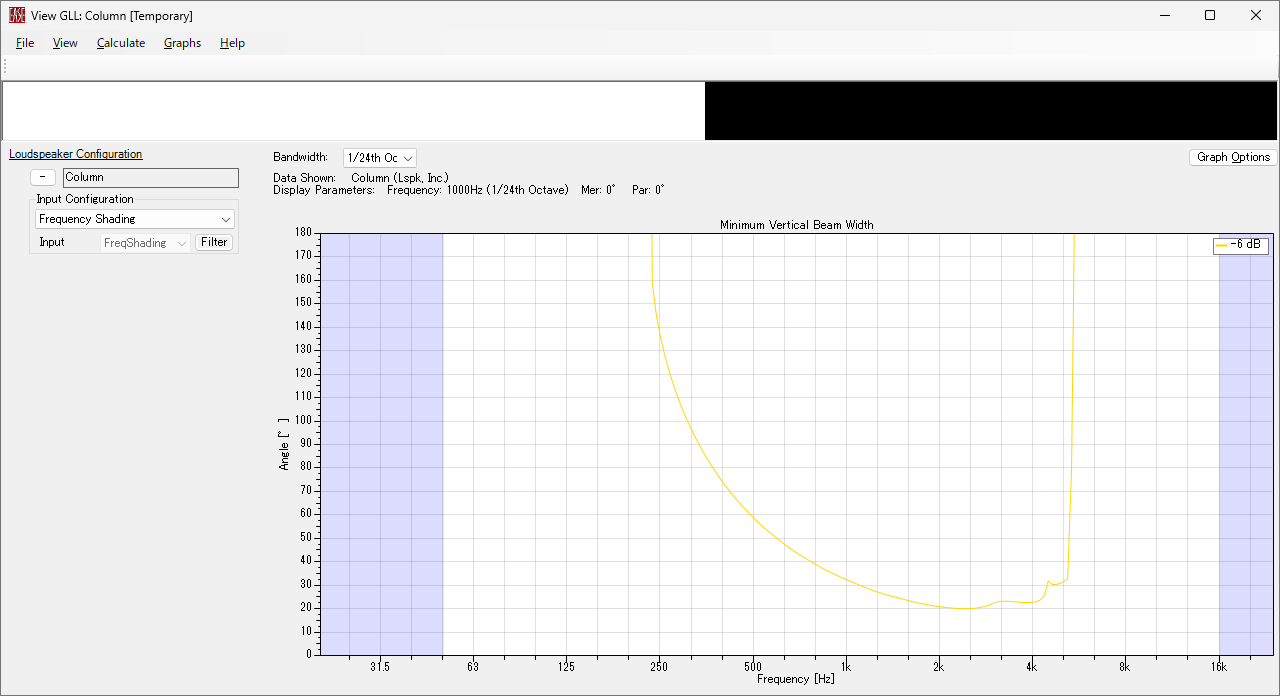
The guide's Fig. 2-193 shows the Minimum Vertical Beam Width narrowing smoothly toward the high end (up to ~16 kHz). My result instead reaches a minimum near 2 kHz and then widens sharply, with the -6 dB metric breaking down (running off scale) above ~4-5 kHz. This seems physically consistent with the strong shading leaving essentially the single unfiltered center driver active at high frequencies (i.e. approaching omni), so I'd expect the beamwidth to open up, not keep narrowing.
Below is my vertical beamwidth result:
Questions:
1. Was Fig. 2-193 generated from exactly the settings described in §2.14.2.3? If not, what settings were actually used?
2. Is there a known erratum for this figure/section?
Thanks for any insight. |
|
|
|
|
| Posted: Thu Jul 23, 2026 1:19 pm |
|
|
|
| Hi,
Could you please send your .xglc SpeakerLab project to support@afmg.eu for review? That would be helpful. |
|
|
|
|
| Posted: Mon Aug 03, 2026 3:47 pm |
|
|
|
| A minor change has since been made to the calculation algorithm, which is causing the discrepancy in the beam width.
However, this is merely an example in the user' manual intended to illustrate the method, not a “real-world” scenario. |
|
|
|
|
| Posted: Tue Aug 04, 2026 12:11 am |
|
|
| d6ha |
| Member |
|
| |
| Joined: 23 Jul 2026 |
| Posts: 2 |
|
|
|
|
|
|
| Thank you for the clarification – that fully resolves my question. Much appreciated. Marking this as solved. |
|
|
|
|
| AFMG Network Forum Index -> EASE 4 |
You cannot post new topics in this forum
You cannot reply to topics in this forum
You cannot edit your posts in this forum
You cannot delete your posts in this forum
You cannot vote in polls in this forum
|
All times are GMT
Page 1 of 1
|
|
|
|
|

 AFMG Network Forum